







A quarter of US loyalty points are never spent. Half of consumers say they'd rather donate their rewards than redeem them. Almost no program connects those two facts. This is the story of the gap.
Loyalty is not in trouble. That is worth saying first, because the number this article is built on sounds like trouble. Antavo's Global Customer Loyalty Report 2026, drawing on a 10,000-person consumer panel, 3,000 marketer responses, and 500 million member actions, finds participation still climbing: 43.2% of consumers are more likely to join a program than a year ago, 65.9% say loyalty programs are part of everyday life, and programs report an average 5.3x ROI.
And yet, inside those healthy programs, something quietly leaks. Of all the points US consumers earn, 26.2% are never spent. 11.9% expire outright. Antavo puts the lost consumer value at roughly $10 billion a year.
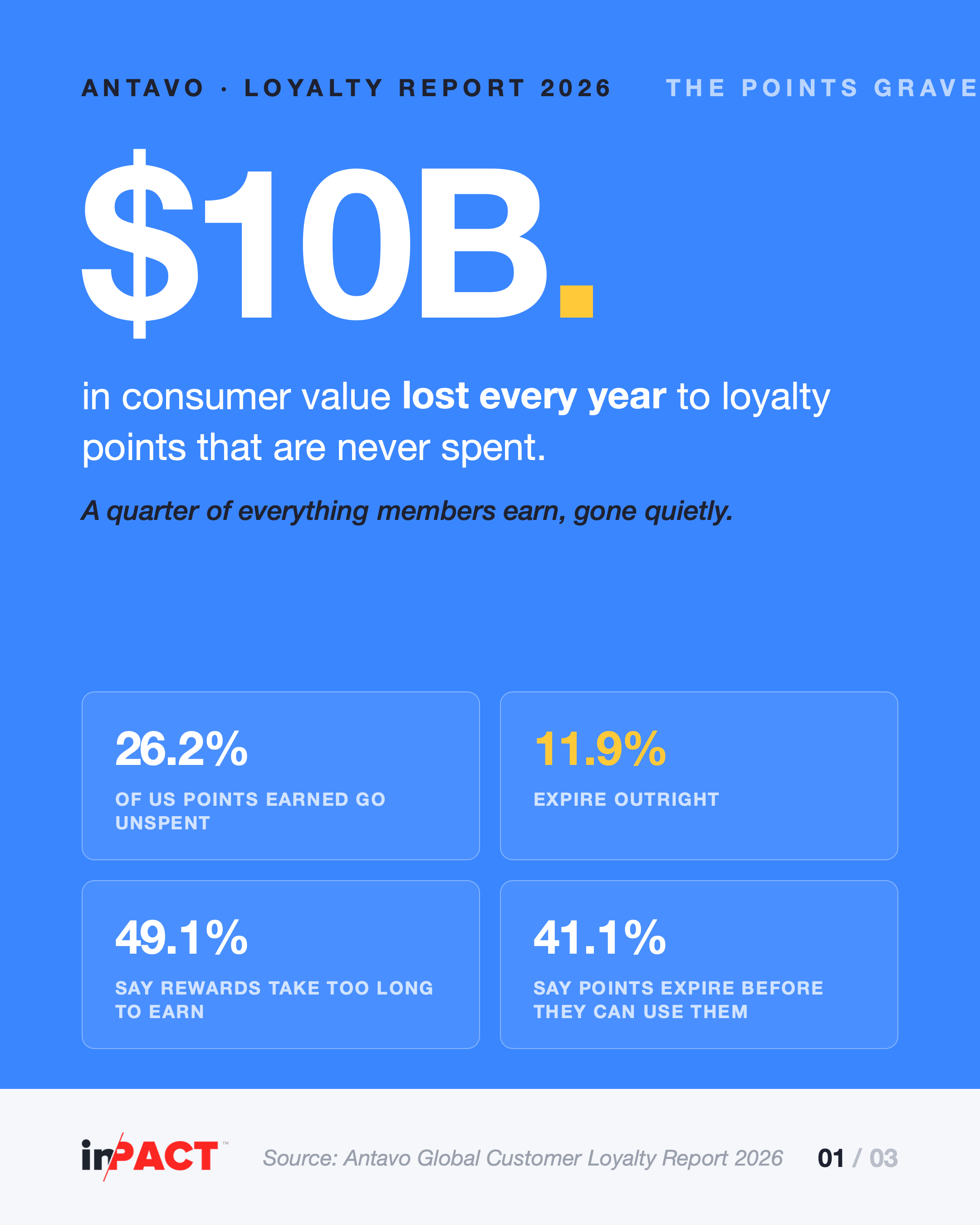
Call it the points graveyard. And before treating it as an American quirk: an independent study, Bond's, now in its sixteenth year, estimates Canadians are sitting on $13 to $15 billion in unredeemed points, with 28% of members redeeming once a year or less. Two countries, two methodologies, one pattern. Members join enthusiastically, earn steadily, and then a quarter of the value goes nowhere.
Why the graveyard fills
The members themselves explain it. In Antavo's data, 49.1% say rewards take too long to earn, 41.1% say points expire before they can use them, and 38.9% find the rewards on offer unattractive. Bond's Canadian data adds the sharpest trendline: ease of redemption jumped from 69% to 73% in importance year over year. The growing pain of loyalty is not getting people in. It is giving them a redemption worth completing.
Here is where program operators should resist a comfortable thought. On the books, expired points look like good news: breakage reduces the liability and flows through as profit. But that 41.1% friction stat is the other side of the same entry. Every expired balance is a member who watched value they earned evaporate. Breakage profit is deferred resentment, booked quarterly.
The gap: members already told us what they want
Now the finding that turns this from a problem description into a design brief. KPMG surveyed more than 18,000 consumers across 20 countries and asked what they would rather do with loyalty rewards. Globally, 52% said they would rather donate them to charity than redeem them personally. In the US, 46%, nearly half. And the appetite is not a Gen Z novelty: Millennials lead at 61%, with Gen Z at 55%, and even Boomers at 40%.
Against that demand, the supply: per EY, 24% of corporate loyalty programs offer donation to charity as a reward option, far behind discounts at 73% and points at 56%.
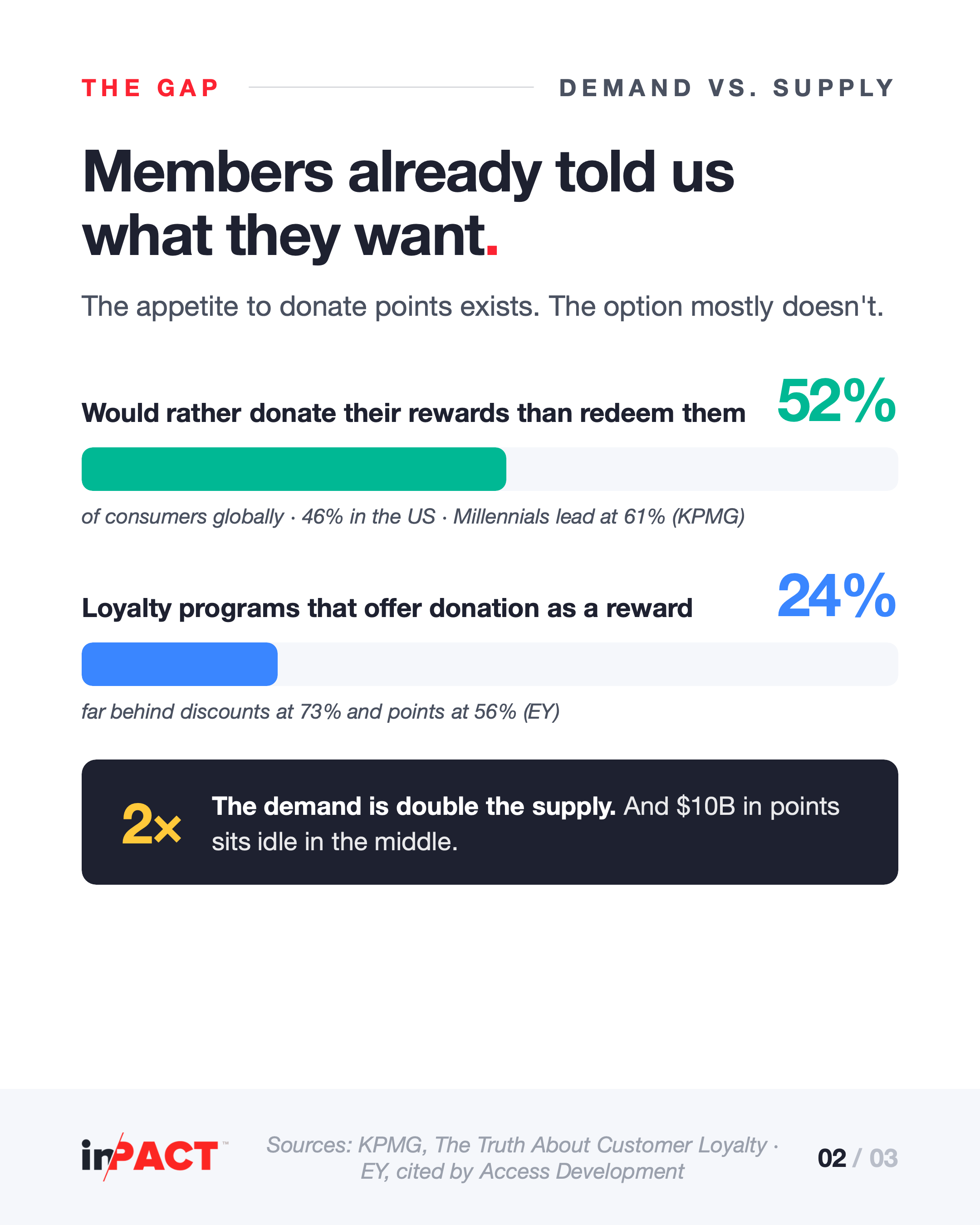
Read those three numbers together. 52% of members want a donation option. 24% of programs have one. $10 billion in value sits idle between them. The demand is double the supply, and the raw material for closing the gap is already on every program's books, depreciating.
One honest caveat, because the data includes it: only 22% of consumers globally say they are loyal to a brand specifically because of its charitable giving. Donation redemption is not a loyalty program's engine. It is a redemption path, an emotional one, for the large cohort of members the discount economy has stopped moving, and for balances that would otherwise expire into resentment.
It works at scale, and has for twenty years
This is not a hypothesis waiting for a pilot. Aeroplan's Member Donation Program marked its twentieth anniversary this May: 1.8 billion points donated since 2006 to over 1,500 charitable organizations, with 100+ active charity partners today. Its sharpest mechanic is worth stealing: Points Matching Weeks, where the program matches member donations up to a campaign cap, have driven over 350 million points in donations on their own. A silent write-off, redesigned as a co-funded campaign moment.
One design lesson from the mature examples, and it is the difference between doing this and doing it well: when programs convert points to donations, the internal conversion rate is typically below market value and rarely disclosed. Members eventually notice. A donation option built on a transparent, published conversion rate is not just cleaner; it is a differentiator in a feature set where opacity is the norm.
Give it forward
The points graveyard is real, quantified twice over, and growing in salience as redemption friction climbs the complaint charts. But it is only a graveyard if the points stay buried. Points that would expire into nothing can become donations members direct, to vetted nonprofits in their own ZIP code. The member gets an emotional reason to come back that a discount cannot manufacture. The program gets a redemption event, a recency reset, and a community story. The liability line becomes an engagement line.
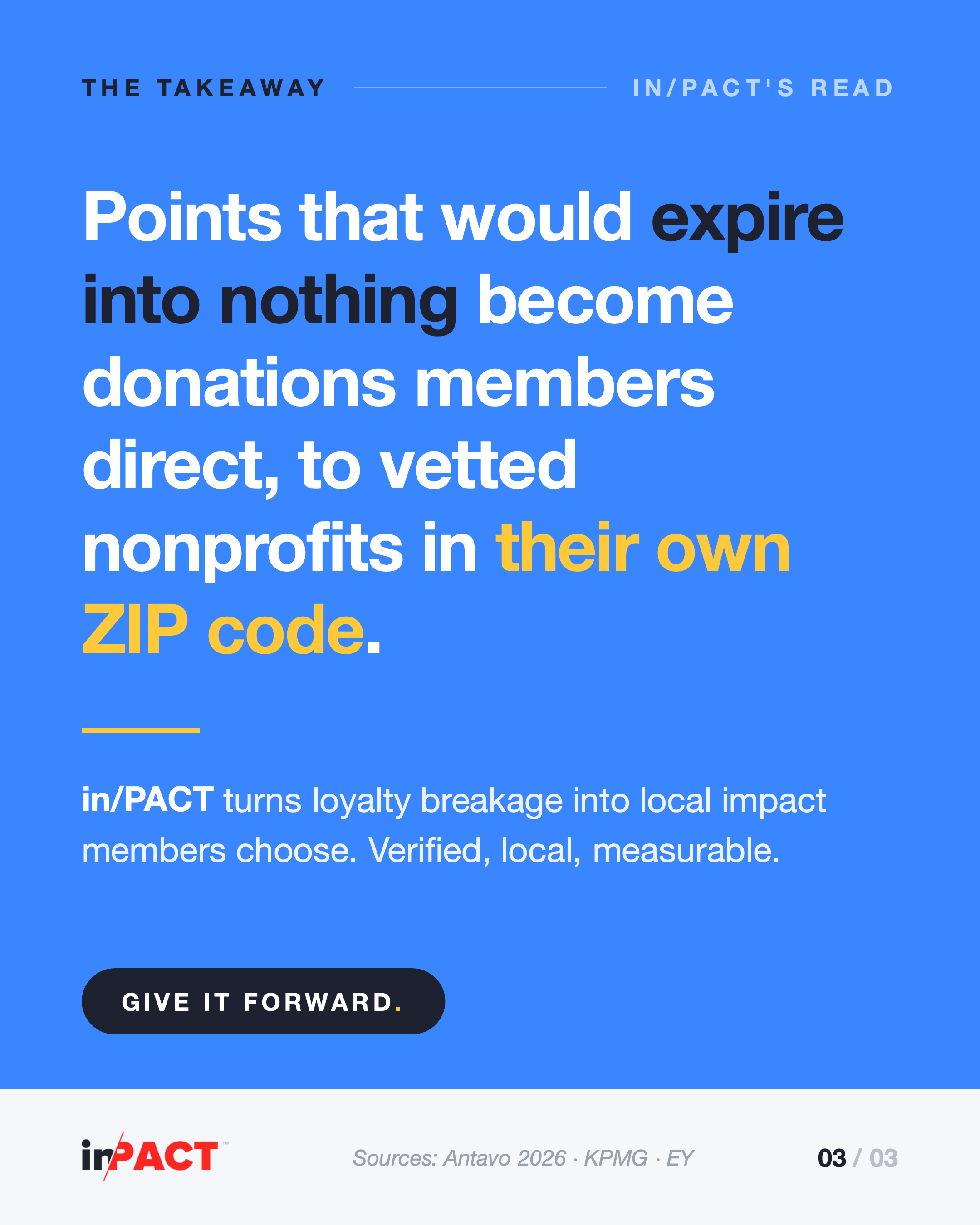
Half your members already told you what they want to do with the points they will never spend. The only question is whether your program is one of the 24% that lets them.
Don't just give back. Give Better.
Sources: Antavo Global Customer Loyalty Report 2026; Bond Loyalty Report 2026; KPMG, The Truth About Customer Loyalty (18,000+ consumers, 20 countries); EY loyalty research cited by Access Development; Air Canada / Aeroplan Member Donation Program 20th anniversary release.
