




Corporate philanthropy hasn’t gone away after the DEI backlash. But for many brands, it’s started to feel like walking through a minefield.
Since 2024, corporate citizenship teams have been caught between three forces at once:
- A polarized political climate where certain grants suddenly become “radioactive”
- The 2025 Tax Reform Act, which changes how and when corporate gifts are deductible
- Persistent pressure from finance to prove that giving isn’t just a cost center, but a driver of growth and loyalty
And yet, companies aren’t turning off the tap. Looking at recent Giving USA and CECP data, corporate giving has held steady, and in some cases grown, even as pretax profits softened. Many leadership teams now talk about philanthropy less as an optional CSR line item and more as long-term investment in reputation, talent and community resilience.
So the real question for brand leaders isn’t “Should we keep giving?”
It’s: “How do we design corporate giving that is politically safer, economically defensible and culturally powerful without losing our soul?”
Using PESTEL as a New Lens On Giving
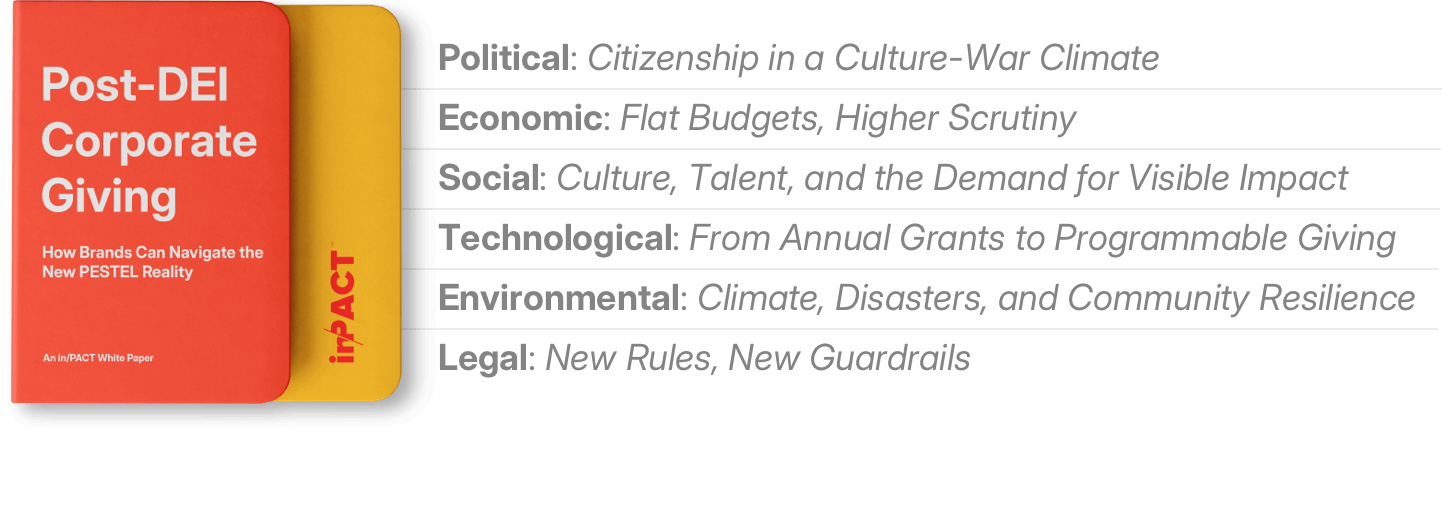
In strategy work we often use the PESTEL framework (Political, Economic, Social, Technological, Environmental and Legal) to map macro forces. In our latest white paper, we apply that same lens to corporate giving and the picture that emerges is… intense.
Get the full white paper -> “Post-DEI Corporate Giving: How Brands Can Navigate the New PESTEL Reality.”
A few signals that stood out:
- Political: Federal scrutiny of DEI is reshaping portfolios, pushing brands toward “safer” ground like education, disaster relief, and hyper-local community grants.
- Economic: New deduction floors and caps mean small, ad-hoc gifts are harder to justify, favoring fewer, larger, and more deliberate commitments.
- Social: Employees and customers still want visible values, but traditional tools like matching gifts reach only a slice of the workforce, leaving big engagement upside.
- Technological: Giving is becoming programmable, embedded in loyalty, POS and apps, but too often lives in silos instead of one coherent impact stack.
- Environmental: Climate risk and local disruptions are forcing brands to invest in community resilience where they operate and source, not just in high-level ESG pledges.
- Legal: The 2025 Tax Reform Act and DEI-related litigation are raising the stakes, driving tighter policies, stronger due diligence, and earlier legal involvement in program design.
Across all six PESTEL dimensions, one pattern keeps reappearing: The safest, smartest path is local, choice-driven, and mission-aligned.
- Hyper-local because proximity lowers political temperature and raises relevance.
- Choice-driven because when employees and customers help decide where funds go, participation and trust climb.
- Mission-aligned because giving that’s tied to the core business (think: travel brands funding safe, sustainable mobility; retailers backing local food security) is much easier to defend in the boardroom and the headlines.
When Social Impact Becomes a Strategic Function
In the white paper, we go deeper into each PESTEL dimension and argue that corporate giving is quietly being rewritten as a strategic function:
- Built with risk modeling, governance, and clear policies from day one, including partner due diligence and grantmaking guardrails that de-risk programs before they launch
- Measured against loyalty, retention, and talent – not just dollars out the door
- Powered by integrated tech stacks that handle vetting, disbursement, and real-time engagement
- Built to create a flywheel where brand investment fuels nonprofit impact, and community impact feeds business growth
If you work in CSR, corporate giving, ESG, brand, HR or loyalty, you’re probably already feeling this shift: more scrutiny, more questions from the C-suite, more pressure to show both impact and ROI.
Our aim with this paper isn’t to add to the anxiety, but to offer a map.
If this resonates, you can read the full white paper, “Post-DEI Corporate Giving: How Brands Can Navigate the New PESTEL Reality.”