





As agent commerce develops, checkout giving raises a personal question: how much of a donation decision would customers want to delegate? For brands and nonprofits, the answer could change where the giving relationship begins.
Imagine asking an AI agent to order your groceries. You’ve specified the budget, the brands you prefer and the substitutions you’ll accept. Then, at checkout, there’s another question: would you like to round up for charity?
You haven’t told the agent what to do about that.
Should it decline because the donation adds to the bill? Ask you? Choose a cause based on what it knows about you? Each response makes a different assumption about your intentions.
That is the unresolved part of agent commerce for customer giving. An agent might have enough information to complete the purchase and still have no clear instruction about the donation.
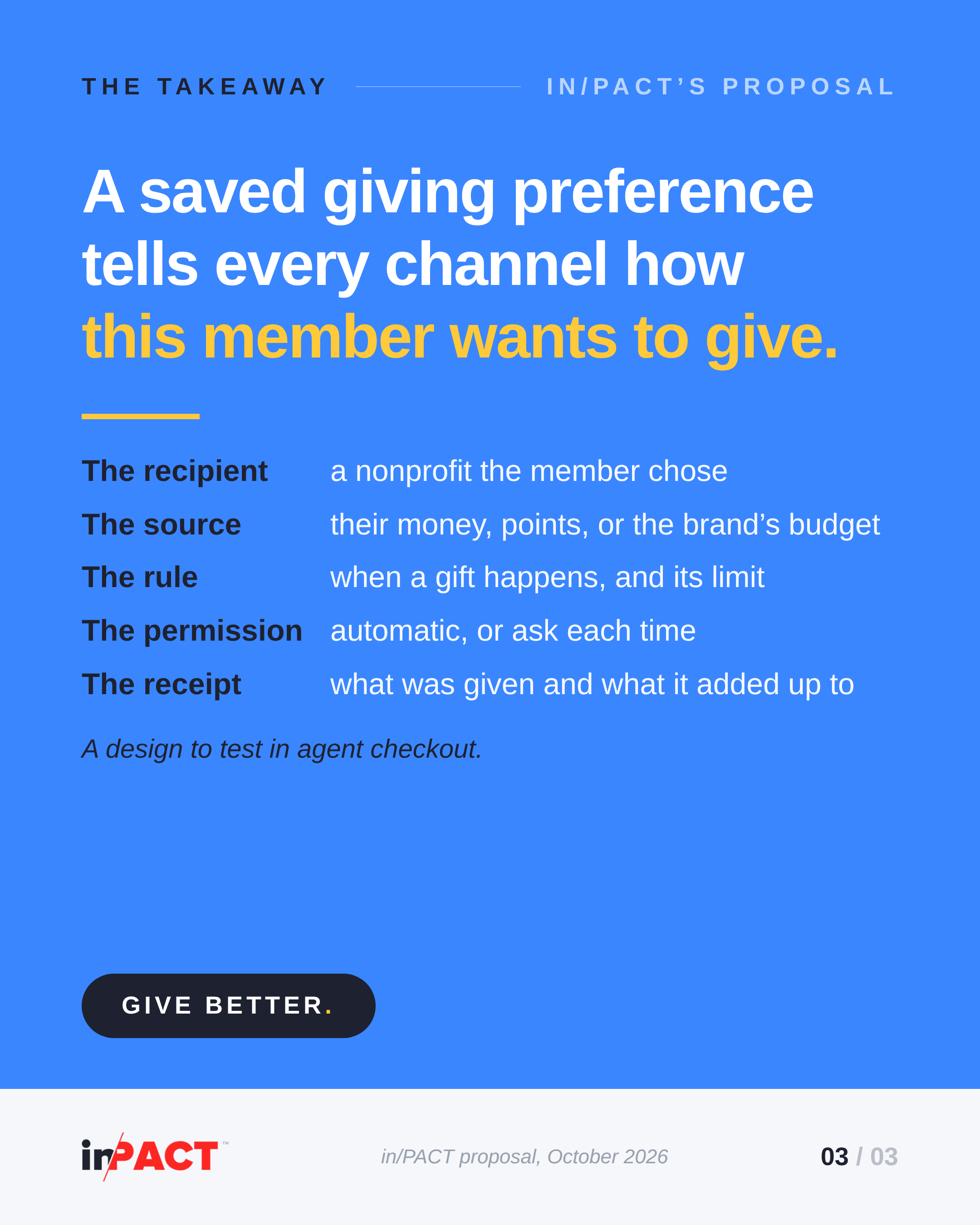
Customers are open to handing over the purchase, on conditions. Adyen found that 51% of 2,000 US consumers aged 16 and over would let AI handle shopping through to the final purchase once their preferences were set. In a separate survey of 2,000 US adults, Visa found that 60% would allow no spending without their approval.
The potential change matters to an established source of funding. Engage for Good’s latest report tracked 92 US checkout campaigns that raised more than $275 million in 2024, with a reported average donation of $1.13. Those figures cover the campaigns in the report, rather than all US checkout giving.
We don’t yet know whether agent checkout reduces giving. Our research found no direct comparison that answers that question. But donation volume is only part of what brands and nonprofits need to understand. The other part is who gets to choose.
An agent can know your loyalty benefits without knowing your giving preferences
Some customer benefits already travel into AI shopping experiences. Target says shoppers in Microsoft Copilot can connect their Target account and retain the extra 5% discount when paying with a Circle Card.
Giving requires a different kind of information. Knowing someone buys pet food would not tell an agent whether they want to support an animal shelter, a food bank or a hospital. Even knowing their favorite nonprofit would leave another question unanswered: do they want to donate on this purchase?
The distinction is visible in the infrastructure. Google’s Universal Commerce Protocol loyalty extension describes three uses: price benefits, non-price benefits and status recognition. In the public protocol and network documentation reviewed for this article, we found no comparable standard for carrying a customer’s chosen charity, giving rule and permission through an agent purchase.
Individual services can still build giving features. The gap in the reviewed documentation does not mean an agent cannot donate. It means a brand should not assume that recognizing a member also tells the agent how that member wants to give.
For a loyalty team, that creates a concrete question to investigate: can the system distinguish a customer who wants to give automatically from one who wants to be asked every time?
Would you let an AI agent choose where you give?
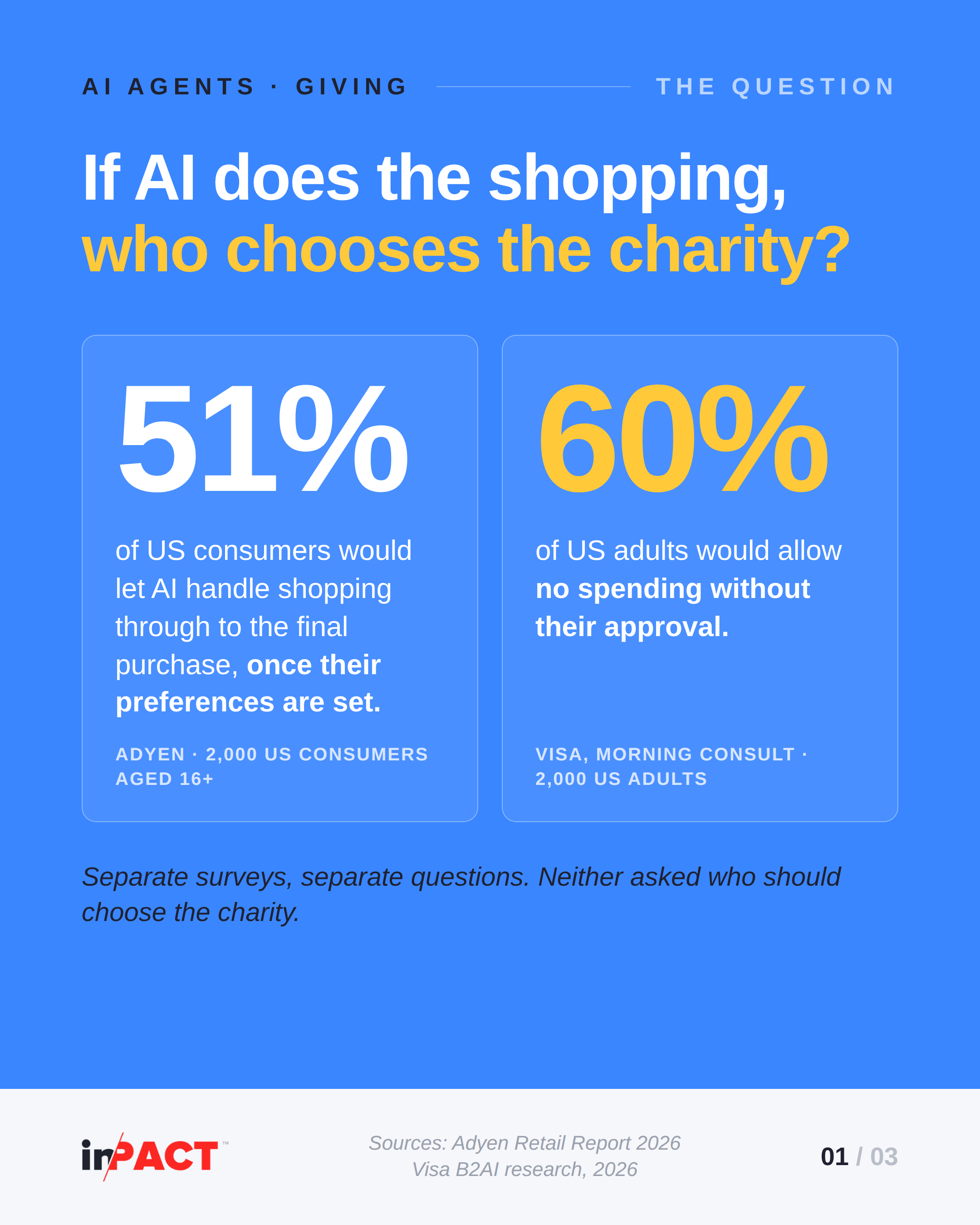
Consider three possible instructions. These are illustrative choices for a future service, not claims about features available across today’s shopping agents.
“Round up my orders for the food bank I’ve chosen, within my monthly limit.”
“Find local food banks and explain the differences. I’ll pick one.”
“Choose the charities and distribute my giving budget.”
The first delegates the task of making a gift. The second asks for help deciding. The third hands over the recipient decision as well. A customer could be comfortable with one and uneasy about another.
The shopping surveys make that distinction worth exploring. Gartner surveyed 322 US consumers in January 2026. Willingness to let AI make purchase decisions topped out at 11%, even in lower-stakes categories. Gartner asked about AI deciding. Adyen’s 51% describes AI completing a purchase after the customer has set preferences, and Visa’s 60% want to approve any spending. The samples and the questions differ, so the results stay separate.
Our reading is that the first instruction asks an agent to carry out a decision the customer has already made, and the third asks it to decide. Gartner’s question was about purchases. If the same reluctance holds for giving, the third instruction would be the hardest one for customers to accept.
None of these surveys asked whether people would trust an agent to select a nonprofit. None tells us whether a standing donation rule would satisfy someone who wants to approve spending. Those answers need to come from customers.
There is a further complication for checkout giving: in a campaign where the brand selects the charity, the customer already chooses from a narrow set of options—support that recipient or decline. A saved giving preference could give the customer more influence over where the money goes, provided the program supports their choice.
That possibility deserves as much attention as the risk of an agent skipping the ask.
A saved choice can keep the customer involved
We already have examples of customers separating the decision to give from the moment a transaction happens.
With Lyft’s Round Up & Donate, riders choose a cause and activate the setting once. Eligible rides then round up automatically. Riders donated more than $5 million in 2025, according to Lyft’s Economic Impact Report.
PayPal’s favorite-charity feature preserves a different level of involvement. The saved choice personalizes an optional $1 request when Give at Checkout appears. The customer still approves the individual gift.
Both models offer something useful for agent commerce. A program could remember the recipient while asking for confirmation, or carry out a recurring instruction within limits the customer has chosen. Learning which arrangement people want is part of the work.
What this could mean for fundraising and nonprofits
The implications that follow are in/PACT’s interpretation of the evidence, not measured effects of agent shopping.
If giving increasingly follows a saved choice, part of fundraising could happen before the shopping begins. The first objective might be to become the nonprofit a customer chooses to support whenever an eligible transaction occurs.
That could make repeat giving easier for an organization already selected. It could also make it harder for an unfamiliar nonprofit to be considered. A program would need to think about both: how it honors an existing choice and how it helps customers discover other causes without continually interrupting them.
If an agent helps with that discovery, the recommendation criteria become consequential. Does it consider local need, the donor’s connection to a cause, evidence of outcomes or familiarity? Could a small community organization explain its work clearly enough to be considered? These are design questions, not evidence that any one group will gain or lose funding.
There is some evidence that a clear explanation can help. In a Stanford-reported experiment involving 1.4 million PayPal users, numerical impact information produced nearly four times the donation rate of a checkout ask with no description. The experiment tested human responses, not AI recommendations. It gives nonprofits a reason to make their outcomes understandable, without claiming that an algorithm will reward them for doing so.
What brands can learn from customer-directed giving
A brand can begin by asking members what they want to choose themselves.
Would they like to support a named nonprofit? Give points rather than cash? Review each gift? Set a recurring limit? A preference expressed in response to those questions could help a brand design the giving experience. It should be used in that context, with permission; a donation choice is not a complete picture of someone’s values.
Loyalty-linked giving could offer another choice: let members direct points to a nonprofit they select. Brands could also test customer-directed grants, where members help decide how the brand’s own giving budget is allocated. The experience should make clear whose money or points fund the gift.
Brands should also consider whether the accumulated result is visible. AmazonSmile directed 0.5% of eligible net purchases to a customer-selected charity, funded by Amazon. When it closed the program in 2023, Amazon said the impact was spread too thin across more than 1 million eligible organizations. That was its stated rationale; it did not establish that customers were indifferent to their chosen cause.
For a new program, the useful question is whether members can see what their participation has contributed to. The answer should be part of the experience they receive after giving.
A proposed path: add a giving preference to the member account
This is in/PACT’s proposal. A brand can build it on the platforms it already runs. It has not been tested in agent checkout.
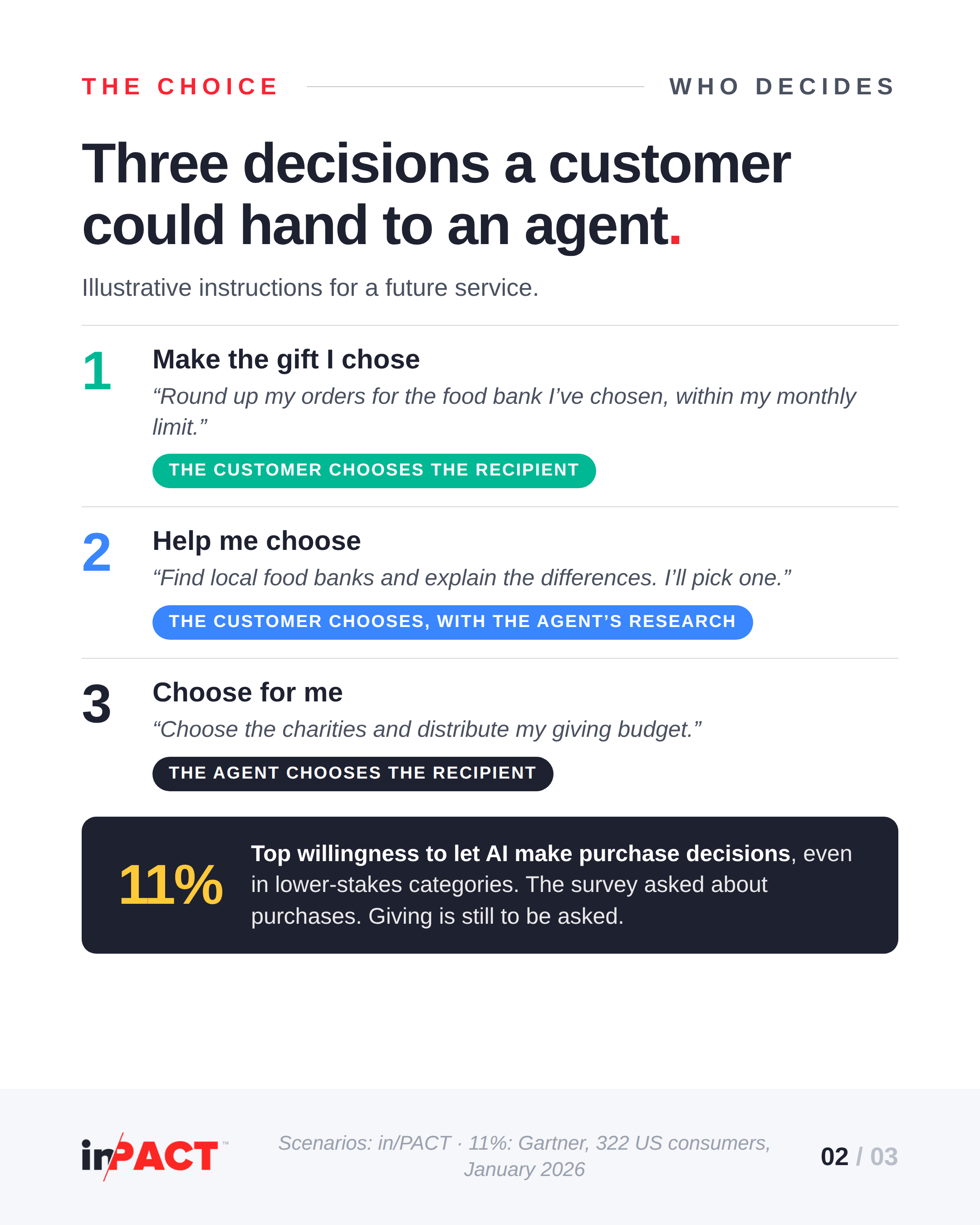
The missing piece is a record. A loyalty platform already stores a member’s tier, points and benefits. A giving preference would sit beside them and tell every channel how this member wants to give. It replaces the broad assumption that a member “cares about the community” with an instruction a program can act on and explain back to the customer.
What the record holds
- The recipient. A nonprofit the member chose, from a list the brand has vetted and is able to pay.
- The source of the gift. The member’s own money, the member’s points, or the brand’s giving budget directed by the member. The record states which one, so it is always clear whose money moved.
- The rule. When a gift happens and how much: round up eligible orders, a fixed monthly amount, a share of points. Every rule has a limit.
- The permission. Give automatically within the limit, or ask each time. The member can review, change or cancel the setting.
- The receipt. What the member sees afterwards: what was given, to whom, and what the gifts added up to.
Where to start
Start with the choice that costs the member nothing. When the brand funds the gift and the member directs it, an agent only has to carry the member’s choice. Nothing is added to the member’s bill, so no extra spending approval is involved. Our reading is that this is the form of giving that asks the least of the 60% in Visa’s survey who want to approve what an agent spends.
Points are the second step for programs that have them. Rules that use the member’s own money, such as round-up, come third. They need the clearest limits and the ask-each-time setting from the first day.
Who owns which part
- Loyalty and CRM: the record in the member account, the permission settings and the points rule.
- Community and CSR: the recipient list, vetting and payout, and the reporting behind the receipt.
- Marketing: the promise made to the customer, and the decision on what the brand funds.
How channels read it
The record is useful before any agent reads it. The app, the website and the store can act on it today, as Lyft’s saved round-up shows. For agent channels, UCP already describes membership recognition through claims supplied by a platform or through the customer’s authenticated identity. Carrying a giving preference along those routes would need additional permissions and integration, and no public specification reviewed for this article defines it yet.
Test the choice before making predictions about checkout giving
An AI-assisted purchase does not necessarily remove the customer from checkout. Shopify’s ChatGPT documentation describes two routes to the merchant’s checkout: an in-app browser or a new browser tab. In those flows, an existing donation prompt can remain available.
For a brand exploring more delegated purchases, a useful test would compare the same giving opportunity across human checkout, agent checkout and agent checkout with a saved preference. Measure donations per eligible purchase, but also whether customers understood the instruction, felt in control and wanted to keep it.
The preference itself needs testing. Some members may want to save only a charity. Others may want automatic giving. Some will want neither. A program should be able to remember those answers as clearly as it remembers the member’s benefits.
At in/PACT, that is the question we think deserves attention now: when a customer lets software complete a purchase, how does their giving choice remain theirs?
Don’t just give back. Give Better.