







Sooner or later, every CEO responsible for a community program hears the same question from the board: What does the business get in return?
BCG has now put some weight behind the answer. In The CEO's Case for Local Civic Engagement, published in August 2026 and informed by interviews with more than 35 CEOs, senior executives, and leaders in the community and philanthropic sectors, the firm argues that local civic engagement is an overlooked source of competitive advantage. Its case rests largely on two things CEOs already watch closely: talent and trust.
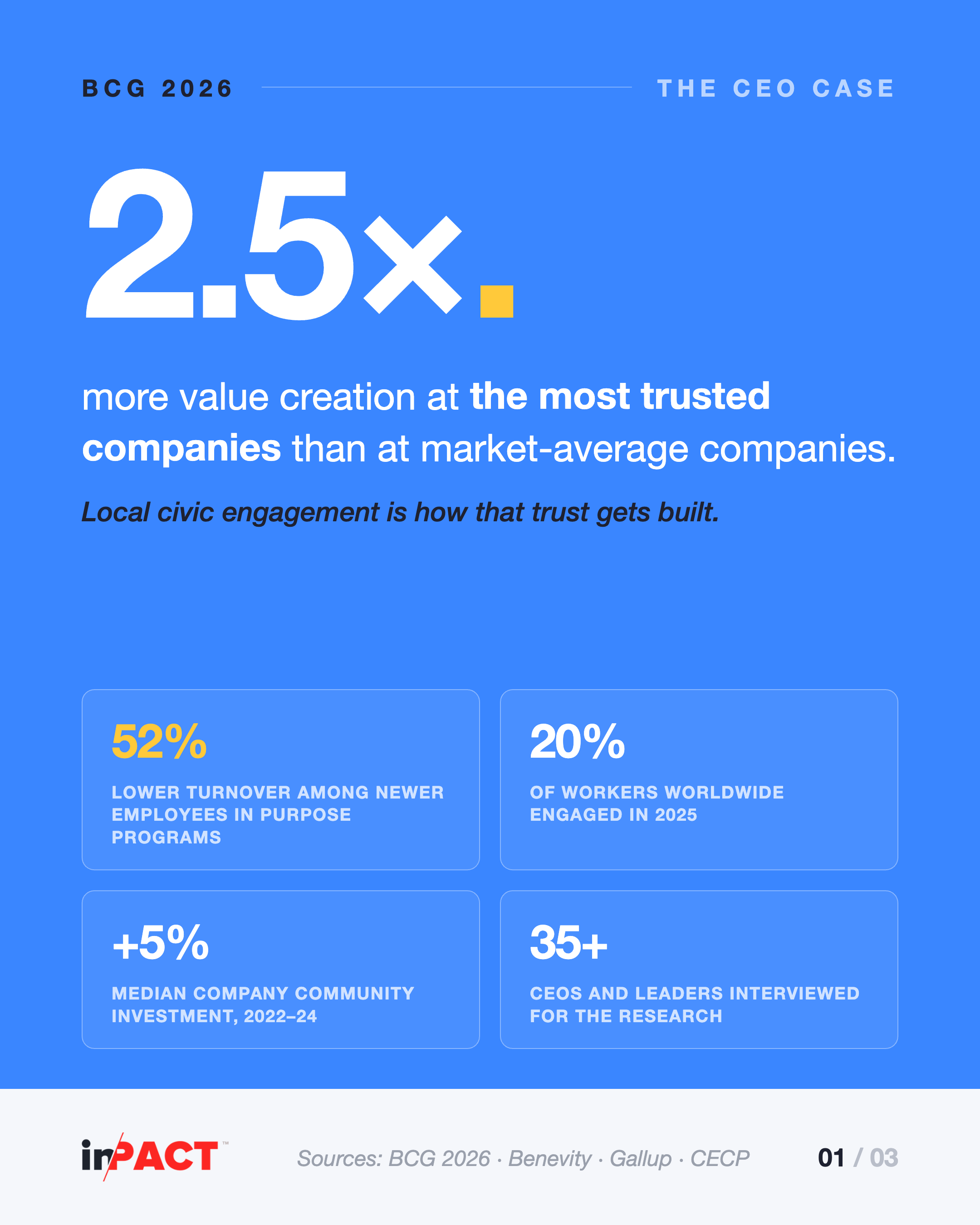
BCG's Trust Index research found that the most trusted companies generated roughly 2.5 times more value than companies with average levels of trust. The talent case is just as striking. Citing Benevity, the report notes that turnover is 52% lower among employees with no more than two and a half years of tenure who take part in corporate purpose programs. Against Gallup's finding that only 20% of workers worldwide were engaged in 2025, the implications for recruitment and retention are hard to ignore.
There is a third benefit in the report, and it may be the easiest to underestimate: civic engagement gives emerging leaders somewhere to test themselves. One company president told BCG that a single organization is, by definition, a closed environment. Put someone on a community board and you see how well they can listen, build support, and lead without the familiar authority of their job title. Companies spend heavily on leadership simulations designed to reveal those qualities. Community work reveals them in the real world.
Why this matters now
Public budgets are tightening just as communities are being asked to shoulder more. According to BCG, spending across a group of more than 200 US cities was flat in 2025 after pandemic-era assistance came to an end. In Europe, two out of three local and regional governments identify a lack of financial resources as the biggest obstacle to progress on poverty, health, education, and other priorities.
At the same time, the pressures facing households are growing. BCG's analysis of 80 large cities found that average mortgage payments reached 64% of household disposable income in 2025, up from 48% in 2021. Add the disruption expected as AI reshapes jobs, and major employers will increasingly be asked to play a constructive role in the places where their people live and work.
Corporate funding cannot close every gap. CECP reports that median company community investment—including cash, pro bono work, and in-kind support—grew 5% between 2022 and 2024. That makes the design of a program at least as important as the size of its budget. The companies making the most progress are not necessarily writing the largest checks. They are clearer about when to listen, where to contribute, and who should lead.
Start with the community
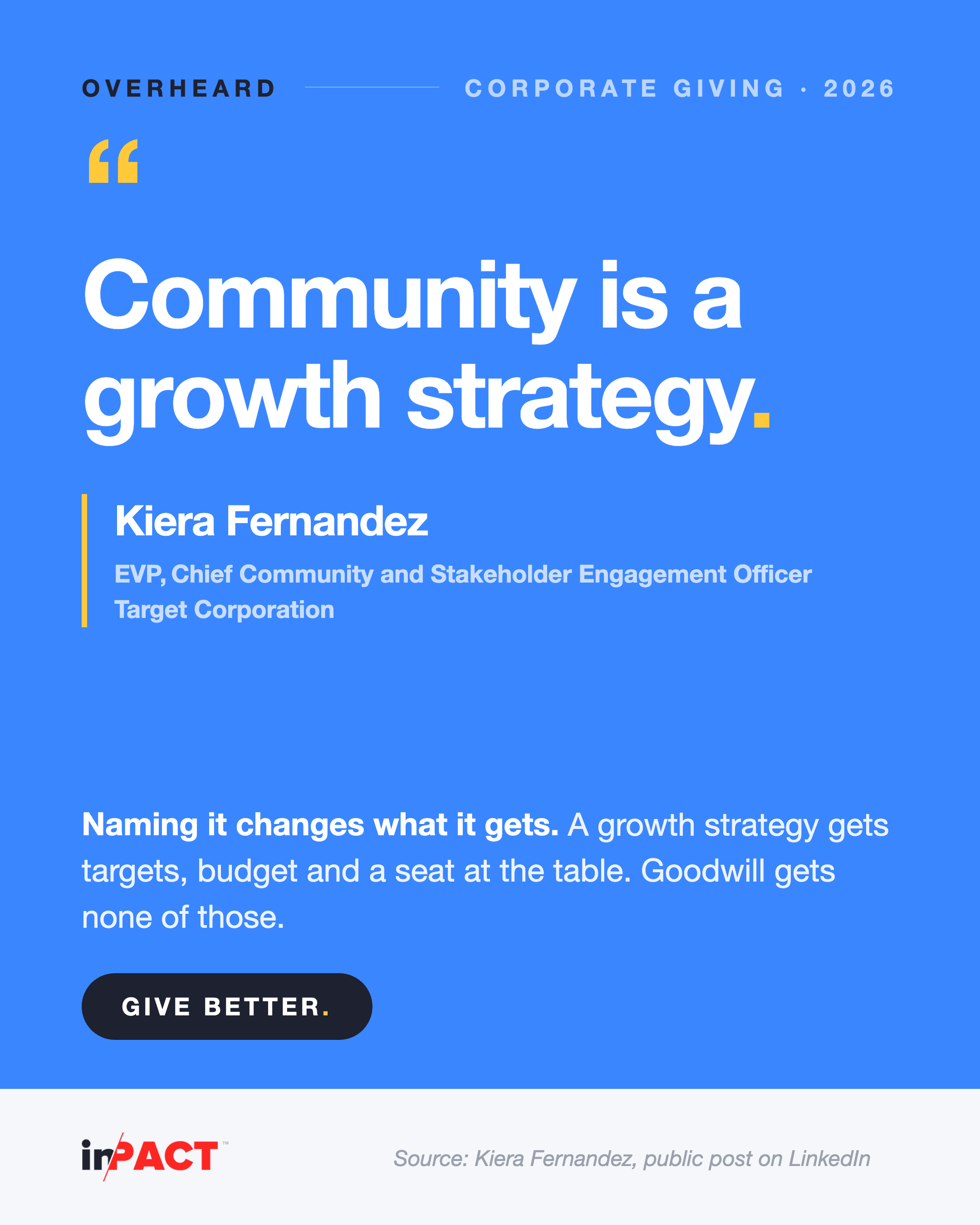
Kiera Fernandez, EVP and Chief Community and Stakeholder Engagement Officer at Target Corporation, summed up the idea in four words in a public post: community is a growth strategy.
The distinction matters. Calling something a growth strategy changes the way a company treats it. It brings clearer goals, sustained investment, and senior attention. It also shapes the way the work begins.
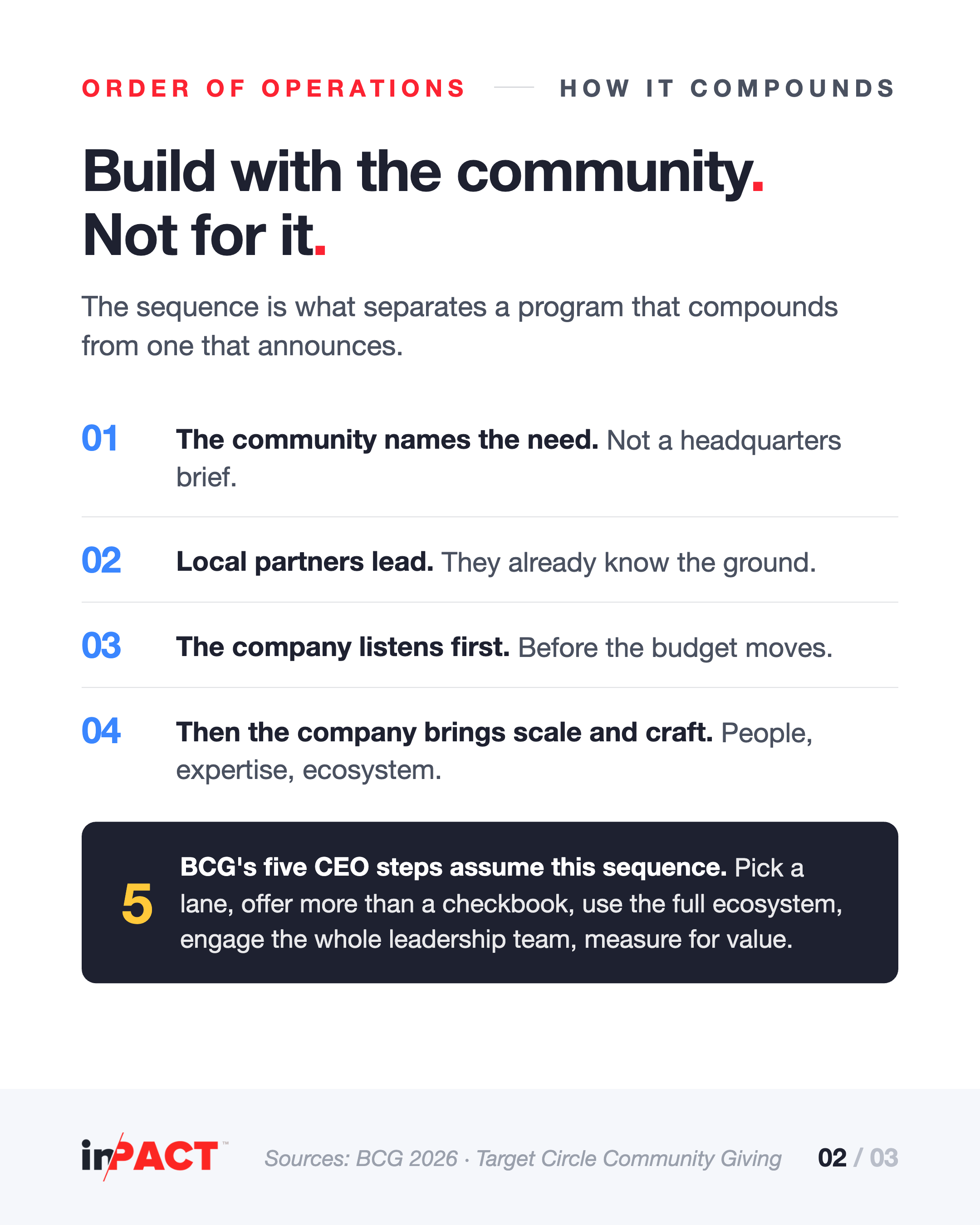
In the strongest examples, the community identified the need and local partners took the lead. The company listened before bringing its scale, people, and design expertise to the work. That was true whether the project involved a farm in Washington, D.C., a shelter in Camden, or a school in Seattle. Hundreds of people rallied around plans shaped by the communities themselves, rather than plans handed to them from the outside.
This community-first approach closely reflects the five steps BCG recommends to CEOs:
Bring in the full leadership team. When community involvement remains confined to the C-suite, a company misses much of its potential impact—and much of the opportunity to develop leaders throughout the business. BCG recommends embedding the work across levels of the organization.
Choose a lane. The strongest strategies focus on issues where the company has useful expertise and can commit for five to ten years. That kind of focus builds knowledge, trust, and credibility over time. A scattered portfolio may look impressive on a page, but it rarely creates the same depth.
Contribute more than money. Funding is important, but it is not always the most valuable resource a company can offer. Technical expertise, training, access to tools, and support in areas such as AI can help community partners build capabilities that last beyond a single grant.
Use the wider ecosystem. A company's supplier network, partnerships, and infrastructure can open doors that smaller community organizations may not be able to access on their own.
Measure the value and govern the work well. Companies need to understand where value is being created, give regional teams room to respond to local priorities, and avoid spreading their efforts across disconnected initiatives.
Taken together, the five steps point to the same principle: the best programs are built with communities, not simply delivered to them.
Bringing customers into community giving
Consumer brands can invite one more group into the process: their customers.
Target offers a useful example of how this can work at scale. The company reports that, through Target Circle Community Giving, guests directed $42 million to 7,950 nonprofits through 2025. Each year, they help direct roughly $7 million of Target's giving to local organizations. Members earn votes when they shop and use those votes to help determine how grants are distributed among participating nonprofits. Target identifies in/PACT and Simple Generosity as the partners that research, select, and welcome those organizations into the program.
Customer participation strengthens each of the returns BCG describes. Trust is built with the public, and customers are part of that public. Customer participation also restores some of the local connection that globalization, remote work, and centralized philanthropy have weakened. For a consumer brand, its customer base is already a detailed map of its local footprint.
It also makes measurement more concrete. Leaders can see which organizations received support, how much was directed in each market, and how customers voted. Those are observable actions, not broad claims about purpose.
There is no need to choose between customer participation and the employee programs BCG highlights. The two reinforce one another. Employees experience the commitment from inside the organization; customers see and shape it from the outside.
 The opportunity for CEOs
BCG is asking CEOs to see local communities differently: not as passive recipients of corporate generosity, but as partners in creating shared value. The research gives fresh support to what experienced community leaders have understood for years.
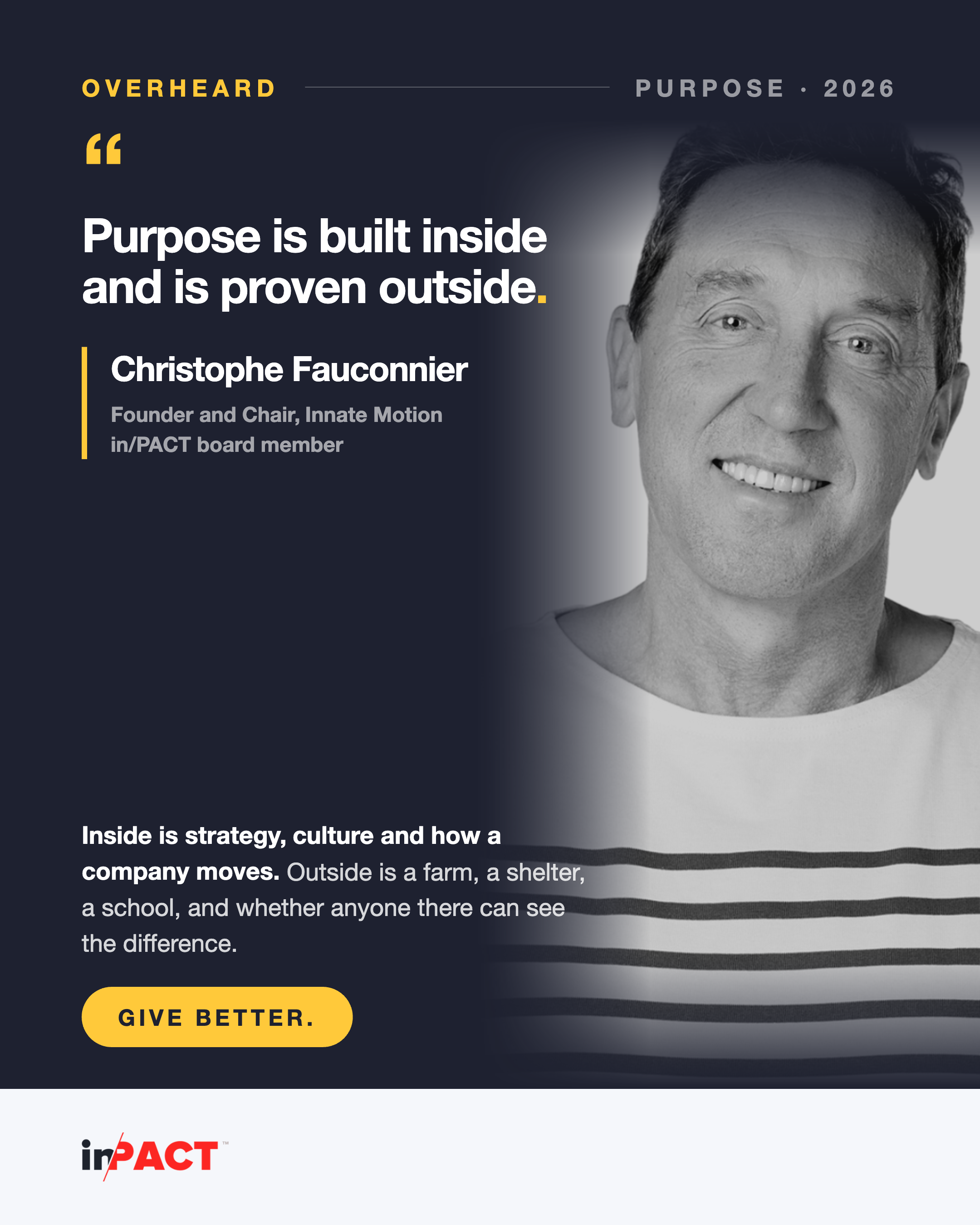
Christophe Fauconnier has a concise way of describing that relationship: purpose is built inside a company, through its strategy, culture, and the way it operates. It is proven outside, where people can see what those commitments amount to—on a farm in Washington, D.C., in a shelter in Camden, or in a school in Seattle.
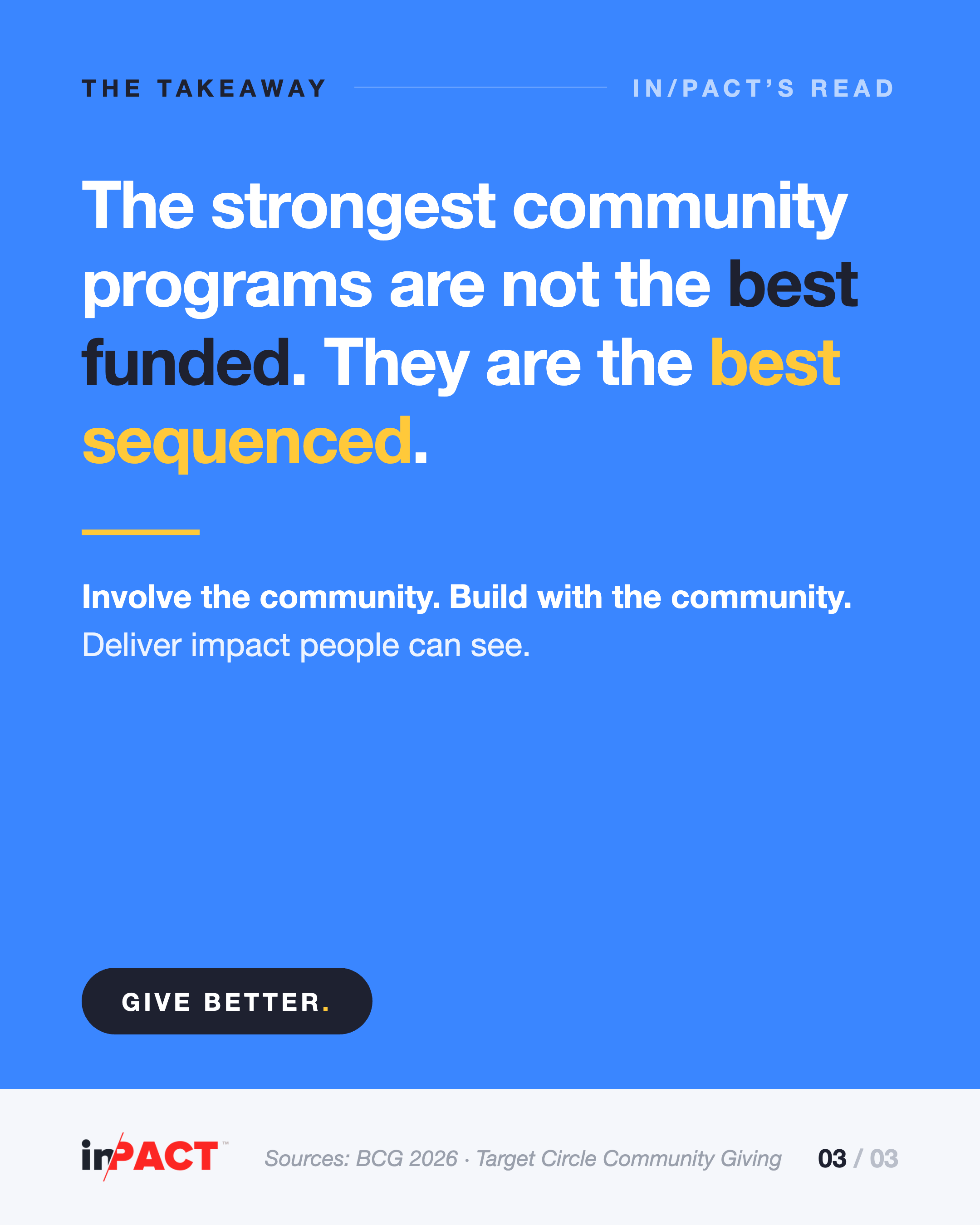
The starting point is simple. Invite the community in early. Listen to the people closest to the need. Then bring the resources and reach of the business to a plan they helped shape.
That is what turns giving into something larger than a corporate gesture. It becomes a shared effort, with results people can see and a stake they can genuinely feel.
Giving is the power of we.
Don't just give back. Give Better.
Sources BCG, The CEO's Case for Local Civic Engagement, 11 August 2026 (Kedra Newsom Reeves and Veronica Chau), including figures BCG attributes to CECP, Gallup, Benevity, the National League of Cities, the OECD, and BCG's own Trust Index and city analysis. Target Corporation, Target Circle Community Giving, corporate.target.com.
